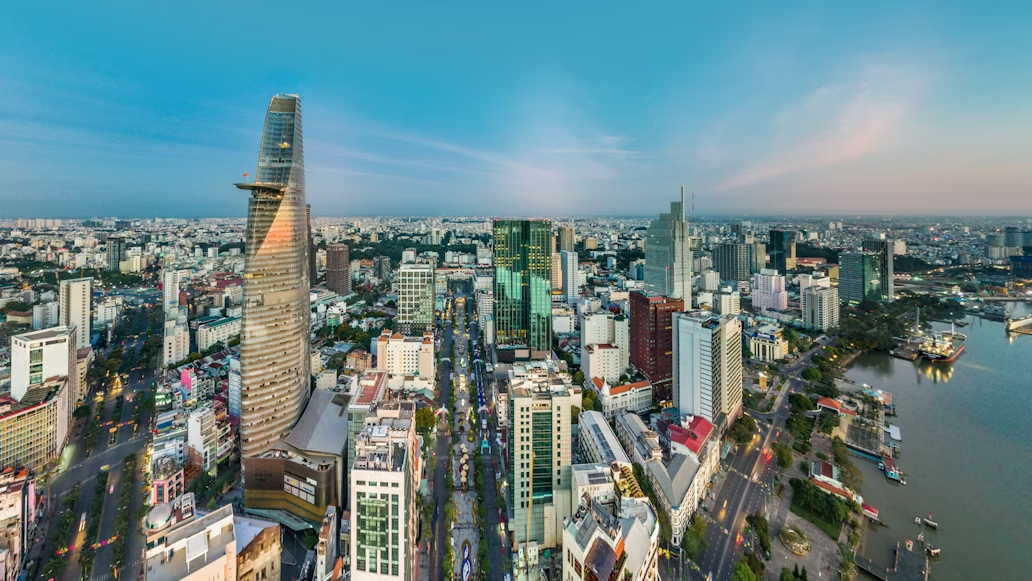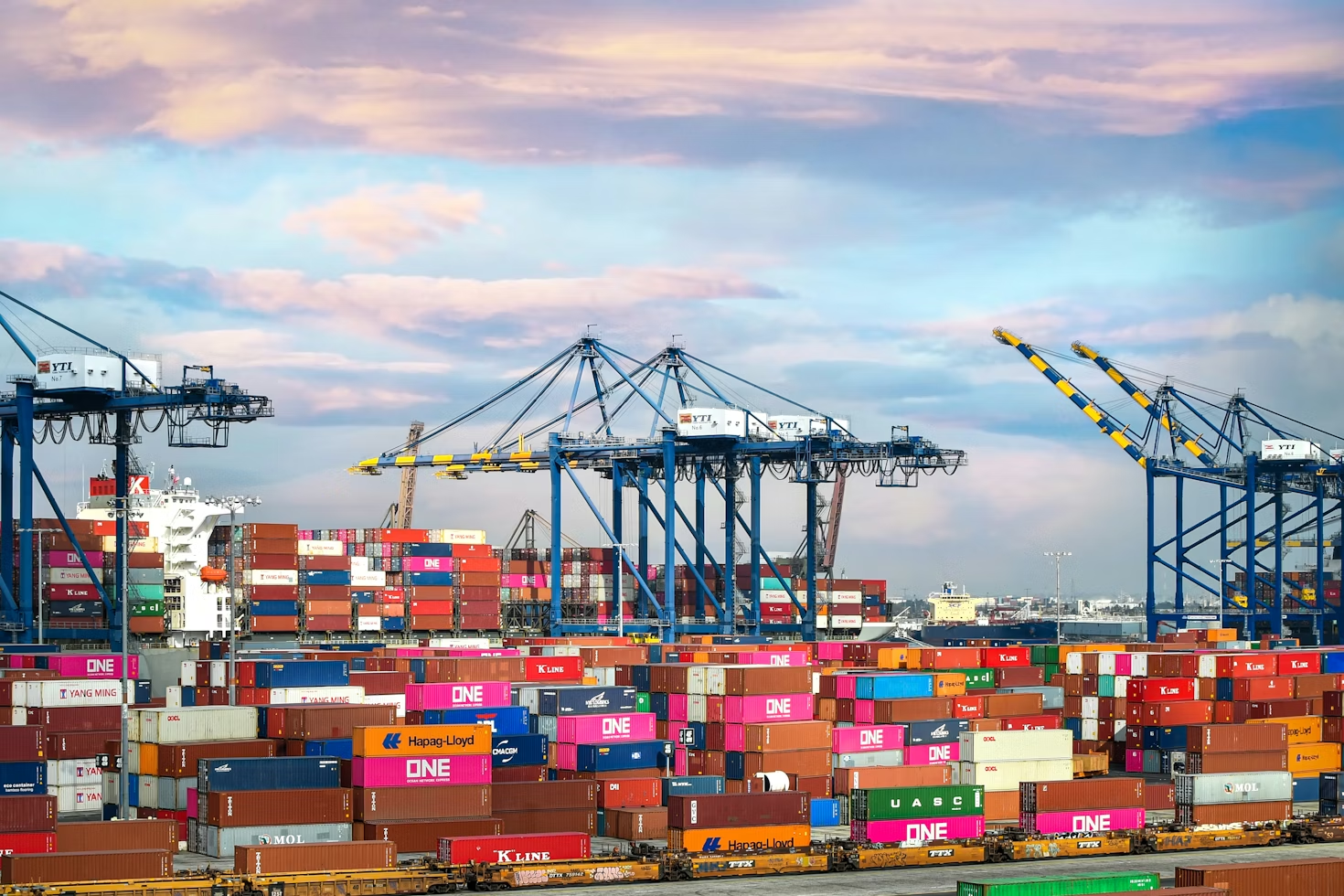
For years, the standard playbook for businesses looking to reduce exposure to US-China trade tensions was straightforward: shift production to Vietnam. That strategy, while still valid in many contexts, is now under significant pressure. In March 2026, the US Trade Representative initiated new Section 301 investigations targeting Vietnam, alongside more than a dozen other Asian manufacturing nations. With reciprocal tariffs of up to 46% now in play, procurement teams are confronting a fundamental question: where do you go when your fallback destination also faces steep new duties?
The Tariff Landscape Has Changed Dramatically
The latest wave of US trade measures has introduced a level of complexity that goes well beyond the original US-China trade war. Goods originating in China now face substantial baseline tariffs, but the net thrown in April 2026 is far wider. Vietnam, Thailand, Indonesia, Cambodia, Malaysia — countries that attracted significant manufacturing investment precisely because they offered a tariff-safe alternative to China — are all now subject to new scrutiny and, in some cases, double-digit import duties.
The 'transshipment' issue has added further complications. US authorities have made clear that goods processed through Vietnam but containing significant Chinese-origin content will attract the higher China tariff rate. For businesses that moved only final assembly to Southeast Asia while keeping their upstream supply chain anchored in China, this creates immediate and serious risk. The compliance burden has risen sharply, and the margin for error is thin.
Why Supplier Diversification Is No Longer Optional
The instinct of many procurement managers has been to diversify — spreading supplier risk across two or three countries to avoid over-dependence on any single origin. Data from Q1 2026 validates this approach: inspection and audit volumes in Southeast Asia grew over 40% year-on-year as businesses accelerated sourcing transitions. Countries like Indonesia and Thailand are attracting increased buyer interest, while India and Bangladesh are also gaining ground for certain product categories.
However, diversification is easier to announce than to execute. Moving production is not simply a matter of signing a new supplier contract. It requires factory qualification, production trials, quality benchmarking, logistics reconfiguration, and ongoing compliance monitoring. Without on-the-ground expertise in the destination country, companies risk trading one problem for another — swapping tariff exposure for quality failures or delivery delays that erode margin just as effectively.
The Role of Quality Control in a Multi-Origin Sourcing Model
As supply chains become more geographically dispersed, the importance of structured quality control increases proportionally. When a business was relying on a single, well-established supplier in one country, quality processes could be relatively lean. As production moves to newer factories in less-familiar markets, the risk profile changes considerably. New suppliers may lack the process maturity, documentation standards, or component traceability that buyers take for granted in long-standing relationships.
Rigorous quality checkpoints — at the facility audit stage, during production, and at pre-shipment inspection — are no longer a premium add-on but a baseline requirement for any multi-origin sourcing strategy. Businesses that skip these steps in the rush to relocate production typically absorb the costs later, through returns, rework, air freight penalties, and reputational damage with their own customers. A risk-based approach to quality, applied consistently across all supplier locations, is the foundation of a resilient sourcing model.
Rethinking Asia: A More Nuanced View of the Region
The procurement narrative of the last decade was dominated by China as the default manufacturing hub and Vietnam as the obvious alternative. The reality of 2026 demands a more nuanced view. Different product categories suit different countries: electronics and precision components have found strong footing in Vietnam and Malaysia; garments and footwear have moved toward Bangladesh, Cambodia, and India; industrial components and raw materials continue to rely heavily on Chinese manufacturing capability that cannot be easily replicated elsewhere in the short term.
Understanding which country is genuinely right for a given product — factoring in tariff exposure, supplier capability, logistics infrastructure, and cost structure — requires regional expertise that goes beyond general market knowledge. On-the-ground presence in Asia, with direct relationships across multiple manufacturing ecosystems, is increasingly the differentiating factor for businesses navigating this new landscape.
Building a Sourcing Strategy That Can Absorb Future Shocks
The lesson of the past several years is that trade policy will remain volatile. Businesses that built their sourcing strategy around a single country or a single policy assumption have repeatedly found themselves caught off-guard. The competitive advantage now belongs to companies that have built sourcing architectures with genuine flexibility — multiple qualified suppliers across multiple countries, clear quality standards applied consistently regardless of origin, and logistics structures that can adapt to shifting tariff regimes without operational disruption.
This kind of strategic resilience requires investment: in supplier relationships, in quality infrastructure, and in the regional expertise needed to identify and qualify new production partners quickly when circumstances demand it. For procurement teams managing these transitions, working with partners who have established networks across China, Vietnam, and the broader Southeast Asian manufacturing ecosystem can significantly compress the timeline from strategic decision to operational execution.
Navigating the New Normal
The tariff environment of 2026 is not a temporary disruption to be waited out — it reflects a structural shift in how the US and other major economies are approaching trade policy. For procurement professionals, the priority is not to find the next 'safe' single-country solution, but to build sourcing models that are genuinely multi-origin, quality-controlled, and adaptable.
Ready to Strengthen Your Supply Chain?
Our team helps businesses build resilient, multi-origin sourcing strategies across Asia — from supplier qualification and quality control to buying office support.
Speak With Our Team