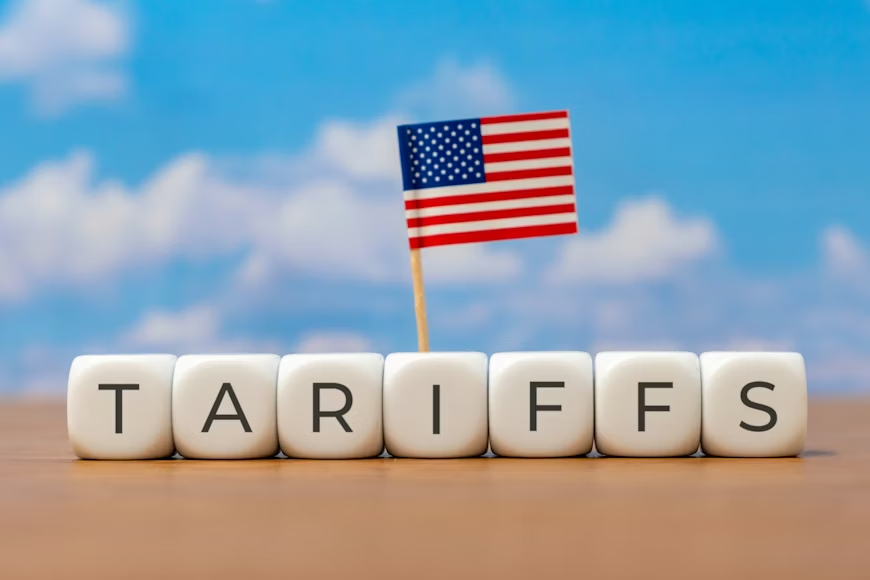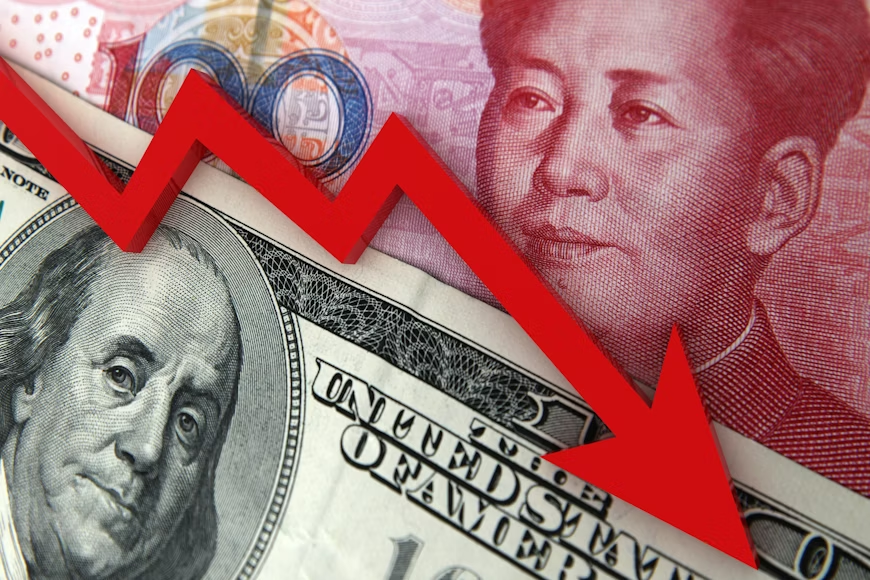
By May 2025, the implications of the April tariff shock were clear: businesses could no longer rely on single-country sourcing strategies. The effective reduction of the de minimis threshold for Chinese goods to zero on 2 May forced a fundamental reassessment. According to recent Deloitte research, 40% of US companies were already planning to relocate part of their supply chain by 2026. Global procurement leaders recognised that diversification had moved from strategic optionality to operational necessity.
The De Minimis Threshold Change and Its Impact
The elimination of the de minimis loophole—which previously allowed shipments under $800 to enter the US tariff-free—removed one of the few remaining avenues for tariff avoidance. This wasn't a marginal policy adjustment; it was structural. Businesses that had tried to work around tariff exposure through creative shipment consolidation now faced the reality that virtually every import from China would carry full duty exposure.
This policy change accelerated the timeline for diversification decisions. Companies that might have spent months evaluating Vietnam, India, or Southeast Asian suppliers suddenly found they needed to move faster. The combination of compounding US tariffs and the de minimis reduction meant that Chinese sourcing, long the default option for global procurement, was becoming increasingly difficult to justify on cost grounds alone.
The Emerging Dual-Sourcing Framework
Rather than abandoning China entirely, forward-thinking procurement professionals were developing a China-plus strategy. Vietnam emerged as the primary alternative, with India and Southeast Asia (Indonesia, Thailand, Malaysia) as secondary options depending on product category and capability requirements. This wasn't simply about cost arbitrage; it was about building resilience through geographic distribution and maintaining access to the world's most competitive manufacturing ecosystems.
The China-Vietnam dual framework offered distinct advantages. China retained its strengths in complex manufacturing, economies of scale, and supplier ecosystem maturity. Vietnam provided lower tariff exposure, growing capacity in labour-intensive industries, and proximity to US trade agreement partners. Companies began treating this as a complementary sourcing architecture: use China for high-complexity products and components where cost-per-unit was less tariff-sensitive, and concentrate labour-intensive, high-volume production in Vietnam and other ASEAN nations.
Building Supply Chain Resilience Through Diversification
Moving beyond theoretical analysis, the practical work of supply chain diversification requires operational discipline. Qualifying new suppliers in Vietnam or India takes time. Manufacturing standards, regulatory compliance, lead times, and quality expectations all need to be vetted and aligned. This is where professional procurement support becomes critical; businesses without on-ground presence in Asia needed access to reliable networks and verification capabilities.
Forward-planning companies were also reconsidering inventory and working capital strategies. Shifting production across multiple countries introduces complexity—longer lead times to Vietnam, different payment terms, currency exposure across multiple Asian economies. Procurement teams needed to model the true total cost of ownership across multiple geographies, accounting not just for unit tariffs but for logistics, financing, and operational complexity.
Your Multi-Country Sourcing Roadmap
By mid-2025, the sourcing landscape was clearly bifurcating. Companies that acted decisively in April and May to establish Vietnam-based procurement capabilities, qualify backup suppliers, and build operational frameworks for multi-country sourcing were positioning themselves for resilience. Those that remained single-sourced in China faced ongoing margin compression and were increasingly vulnerable to future tariff escalation.
Ezysupplie's manufacturing and procurement network across China and Vietnam, combined with our buying office expertise and quality control infrastructure, enables you to execute a true multi-country sourcing strategy with confidence. We work directly with your procurement team to identify and qualify suppliers in the right geographies, manage production across multiple sites, and maintain consistent quality standards regardless of where manufacturing occurs. Whether you need to establish new supplier relationships in Vietnam, manage a phased transition away from China-only sourcing, or build resilient, tariff-resistant supply chains, having a trusted procurement partner with real boots on the ground across Asia is essential to success in 2025 and beyond.
Ready to Strengthen Your Supply Chain?
Our team helps businesses source with confidence across Asia — from trade fair support and quality control to end-to-end procurement.
Speak With Our Team